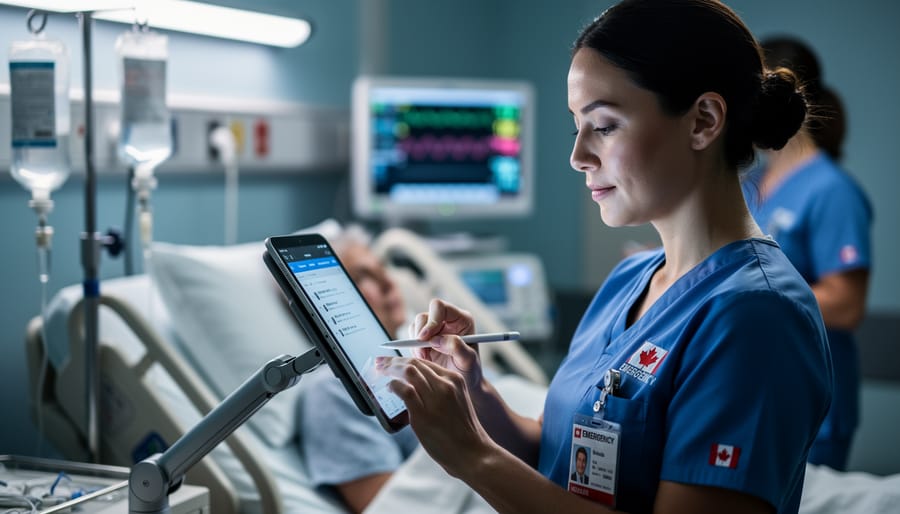
Document every clinical interaction with precision by recording vital signs, interventions, patient responses, and outcomes in real time. Sarah Chen, an emergency room nurse at Vancouver General Hospital, learned this during her first code blue when she realized her hastily scribbled notes couldn’t reconstruct the timeline of medications administered. Good nursing notes protect both patients and practitioners.
Structure your documentation using the SOAP, DAR, or PIE formats consistently across all entries. These frameworks ensure you capture assessment data, nursing actions, and patient responses in a logical sequence that other healthcare team members can follow instantly. A medication error was caught at Toronto Western Hospital because one nurse’s DAR note clearly documented a patient’s allergy history that contradicted a new prescription order.
Include objective measurements alongside subjective patient statements rather than vague descriptors. Write “patient reports pain 7/10 in right lower quadrant, guarding noted on palpation, vital signs stable” instead of “patient uncomfortable.” Canadian nursing regulatory bodies scrutinize documentation during audits and complaint investigations, making specificity your strongest defense.
Describe what you see, hear, and measure without inserting judgment or assumptions about patient behavior. The phrase “patient refuses medication” became “patient states ‘I don’t want that pill right now’ after explanation of purpose provided” in the chart of a Winnipeg nurse facing a complaint. That single documentation choice demonstrated professional communication and preserved therapeutic relationship evidence.
These examples will show you exactly how experienced Canadian nurses document complex scenarios while meeting legal standards and supporting continuity of care.
Why Your Nursing Notes Matter More Than You Think
You might think nursing notes are just paperwork, something to complete before the end of your shift. But in the Canadian healthcare system, your documentation serves as a legal record, a communication lifeline, and sometimes the difference between a near-miss and a serious adverse event.
Every entry you make becomes part of a patient’s permanent medical record. If a case ends up before the College of Nurses or in civil litigation, your notes will be scrutinized. They need to paint an accurate picture of what you observed, what you did, and why you made specific clinical decisions. Vague or incomplete documentation won’t protect you if questions arise years later about the care you provided.
Beyond legal protection, your notes bridge the gaps between shifts and disciplines. The physician reviewing charts at 2 a.m., the physiotherapist planning tomorrow’s session, the social worker arranging discharge support, they all rely on your observations to make informed decisions. When you document effectively clearly and thoroughly, you strengthen the entire care team’s ability to respond appropriately.
Sarah, an RN at a community hospital in Ontario, saw this firsthand during a busy night shift. A patient was scheduled to receive an antibiotic, but Sarah noticed something in the previous nurse’s notes about the patient mentioning “feeling weird” after taking penicillin years ago. The original note included specific details: facial tingling and a racing heart. It wasn’t documented as a formal allergy, and the pharmacy hadn’t flagged it.
Sarah held the medication and contacted the physician. After review, they switched antibiotics. The patient later confirmed a penicillin sensitivity that had never been properly recorded. “If that nurse hadn’t written down exactly what the patient said, I wouldn’t have caught it,” Sarah recalls. “Those few extra sentences potentially prevented a serious reaction.”
Quality improvement initiatives also depend on accurate documentation. When hospitals track infection rates, fall prevention measures, or pain management outcomes, they’re analyzing the data you record. Following proper documentation practices ensures your contributions to patient care are visible and measurable.
Your notes matter. They protect you, inform your colleagues, and safeguard your patients. That’s why learning to document effectively isn’t optional, it’s a core nursing competency that deserves your attention and continuous improvement.

What Makes a Nursing Note Effective
High-quality nursing documentation serves as the foundation for patient safety, continuity of care, and legal protection. Understanding what separates exceptional nursing notes from merely adequate ones can transform your practice and protect both you and your patients.
Sarah, a medical-surgical nurse in Toronto, learned this lesson during a medication error review. Her detailed, objective nursing note clearly documented the patient’s baseline confusion and the steps she took before administering medication, ultimately protecting her license when questions arose weeks later. “I used to think thorough documentation was just busywork,” she recalls. “That experience showed me it’s my professional safety net.”
Effective nursing notes share five core characteristics that align with documentation guidelines for nurses across Canada:
- Accuracy: Record precisely what you observe, assess, and do, using specific measurements and descriptions rather than vague terms
- Timeliness: Document as close to the event as possible, ideally within the same shift, to ensure details remain fresh and reliable
- Objectivity: Distinguish between observable facts and subjective interpretations, avoiding judgmental language or assumptions
- Completeness: Include all relevant information about the patient’s condition, interventions performed, and responses observed
- Clarity: Write legibly (if handwritten) and use clear, concise language that any healthcare provider can understand
Accuracy means writing “heart rate 118 bpm, regular rhythm” instead of “heart racing.” This precision matters in Canadian healthcare settings where notes become part of the permanent legal record and guide treatment decisions across multidisciplinary teams.
Timeliness protects the integrity of your documentation. Waiting until the end of a 12-hour shift increases the risk of forgotten details or mixed-up information between patients. Many provinces now mandate electronic health records that timestamp entries, making late documentation obvious.
Objectivity requires discipline. Writing “patient appears drug-seeking” crosses a line, while “patient requesting hydromorphone q1h, states pain 9/10 despite receiving dose 45 minutes ago” provides factual information without bias.
Completeness doesn’t mean writing a novel. It means capturing the full clinical picture: what you found, what you did, how the patient responded, and what you communicated to whom. Missing any piece creates gaps that compromise care.
Marcus, an emergency nurse in Vancouver, emphasizes clarity. “I write every note imagining another nurse reading it at 3 a.m. without access to me for questions. If they can’t understand exactly what happened and what needs follow-up, I haven’t done my job.”
These principles work together. A note can be timely but inaccurate, or complete but unclear. Excellence requires all five elements working in harmony to create documentation that truly serves patient care.
Good Nursing Notes Examples You Can Use Today
Patient Assessment and Admission Notes
A thorough admission assessment sets the foundation for patient care throughout their hospital stay. Sarah, a registered nurse working in a busy medical unit in Toronto, shares how she structures her admission notes to capture essential information while maintaining readability for the entire care team.
“The key is being comprehensive without becoming repetitive,” Sarah explains. “I want anyone reading my note to immediately understand who this patient is, why they’re here, and what needs attention.”
Here’s an example of an effective admission note:
Patient: M.L., 68 y/o female
Admitted: 2024-01-15, 14:30
Diagnosis: Community-acquired pneumonia, Type 2 diabetes

HPI: Patient presented to ED with 4-day history of productive cough (green sputum),
fever (38.9°C), dyspnea on exertion. Reports decreased appetite, fatigue.
Denies chest pain, hemoptysis. Lives alone, daughter visits daily.

Allergies: Penicillin (rash)
Medications: Metformin 500mg BID, Ramipril 5mg daily

Vital Signs: BP 142/88, HR 96, RR 22, Temp 38.4°C, SpO2 91% on RA
Height: 165cm, Weight: 72kg

Physical Assessment:
- Resp: Decreased air entry RLL, crackles noted. Productive cough present.
- CV: Regular rate and rhythm, no murmurs. Peripheral pulses palpable.
- GI: Abdomen soft, non-tender. Bowel sounds present x4.
- Skin: Warm, dry. Turgor adequate. No breakdown noted.
- Neuro: Alert and oriented x3. Following commands appropriately.

Initial Care Plan: O2 via NC to maintain SpO2 >92%, IV antibiotics as ordered,
respiratory assessment q4h, encourage PO fluids, diabetic diet, fall precautions.
This format provides a clear snapshot while using standard medical terminology. Notice how the assessment flows logically from history to current presentation to physical findings, creating a complete picture that guides subsequent care decisions.
Medication Administration and Response Documentation
Accurate medication documentation protects both patients and nurses. Sarah, an RN working nights at a Toronto hospital, learned this early in her career when a colleague’s detailed notes caught a prescribing error that could have caused serious harm. Since then, she’s been meticulous about recording every detail.
For routine medications, strong documentation includes the time, route, dose, and site when applicable. Here’s an example:
“0900 – Metformin 500mg PO administered with breakfast. Patient tolerated without complaint. No nausea or gastrointestinal distress noted. Blood glucose 6.8 mmol/L pre-administration.”
PRN medications require additional context about why they were given and their effectiveness:
“1430 – Patient reports headache 7/10, throbbing, bilateral temporal region. Acetaminophen 650mg PO administered as ordered. Patient resting in dimmed room. 1530 – Patient reports headache reduced to 3/10, states ‘much better.’ Tolerated medication well, no adverse effects noted.”
Adverse reactions demand immediate, thorough documentation:
“1045 – Cefazolin 1g IV administered via existing peripheral line, left forearm. 1055 – Patient reports itching and ‘feeling weird.’ Erythematous rash noted on chest and neck, spreading. Respirations 22/min, no stridor or wheezing. BP 138/84, HR 98. IV stopped immediately. Dr. Patel notified at 1057. New order received for diphenhydramine 50mg IV. Rash began subsiding by 1130. Patient monitored continuously, vital signs stable.”
These examples show how proper documentation creates a complete picture of medication safety and patient response, protecting everyone involved in care.
Pain Assessment and Management Notes
Pain documentation requires precision and consistency. Canadian nurses must accurately capture both subjective reports and objective observations to ensure continuity of care and compliance with provincial standards.
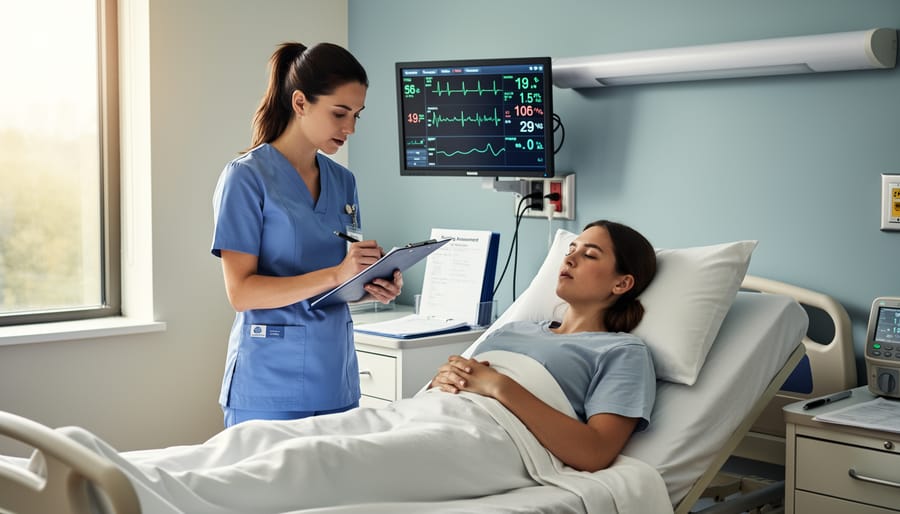
Effective pain notes always include the specific scale used. A well-documented example reads: “Patient reports 7/10 pain in right lower quadrant using numeric rating scale. Pain described as sharp and constant, worsening with movement. Grimacing noted, guarding abdomen. Administered hydromorphone 1mg IV at 1430hrs as ordered.” This note captures location, intensity, quality, and the intervention.
Marie, a medical-surgical nurse in Ottawa, shares her approach: “I learned early on that vague pain notes like ‘patient comfortable’ don’t cut it. Now I document every reassessment with the same detail as the initial assessment.” She’s right. Follow-up documentation is equally critical: “Pain reassessed at 1530hrs, patient reports 3/10 pain, states medication provided relief, no longer guarding, resting quietly.”
Using standardized pain assessment tools appropriate to your patient population strengthens your documentation. For pediatric patients, specify which tool you used: “Pain assessed using FLACC scale, score 6/10. Patient crying, requires reassurance.”
Always document non-pharmacological interventions too: “Repositioned patient to left side, applied heat pack to lower back, dimmed lights. Patient reports improved comfort.”
Change in Patient Condition
Documenting sudden changes in patient status requires quick thinking and thorough detail. These notes become crucial records during emergencies and provide essential information for the entire healthcare team.
Consider this example from Sarah, an RN working in a Toronto medical unit: “1430: Patient found diaphoretic, pale, c/o sudden chest pain rated 9/10, radiating to left arm. Previously stable and ambulatory. BP 88/52 (baseline 128/76), HR 118 irregular, RR 26, O2 sat 89% on RA. Patient placed in semi-Fowler’s position, O2 applied at 4L via nasal prongs. Dr. Chen paged STAT at 1432. 12-lead ECG obtained at 1434 showing ST elevation in leads II, III, aVF. IV access established, NS running at KVO. Patient remains responsive but anxious. Continuous cardiac monitoring initiated. Code STEMI called at 1436.”
This note captures the clinical picture systematically. Sarah documented what she observed first, the measurable changes in vital signs, and each intervention with precise timing. She included the physician notification and the diagnostic findings that guided treatment decisions.
The key is objectivity paired with completeness. Describe what you see, hear, and measure. Record exactly when you notified the physician and their response. Document every intervention and the patient’s reaction. These details protect both you and your patient, creating a clear timeline that other providers can follow if the situation escalates or requires review later.
Patient Education and Discharge Planning
Documenting patient education requires more than checking a box. Strong notes capture what you taught, how you taught it, and most importantly, whether the patient understood.
Melissa, an RN at a Toronto cardiac care unit, learned this during a quality review. “I used to write ‘discharge teaching completed,’ but when a patient was readmitted, there was no record of what we’d actually covered or if he understood his medication changes.”
Here’s an effective example: “1400h: Reviewed post-CABG discharge instructions with patient and wife. Discussed wound care, activity restrictions, and cardiac rehab referral. Patient demonstrated proper sternal precautions and verbalized understanding of lifting restrictions (nothing over 10 lbs for 6 weeks). Wife able to describe signs of infection to watch for, including redness, drainage, increased pain. Both demonstrated understanding of medication schedule using teach-back method. Patient correctly stated purpose of new medications and timing. Written instructions provided in English. Patient voiced no concerns at this time. Follow-up appointment confirmed for April 15.”
The teach-back method documentation is critical. Instead of “patient understands,” describe what they said or did to prove comprehension. “Patient correctly explained how to use insulin pen” provides evidence of learning.
For discharge planning, include barriers you identified. “Patient expressed concern about affording medications. Social work consulted for assistance programs” shows comprehensive care and creates continuity for follow-up teams.
Common Documentation Mistakes Canadian Nurses Should Avoid
Even experienced nurses fall into documentation traps that can compromise patient safety and legal protection. Understanding these pitfalls helps you create clearer, more defensible records.
Sarah, an RN working in a Winnipeg emergency department, learned this lesson during a legal review of her charts. “I thought I was documenting thoroughly,” she recalls. “But when our legal team reviewed my notes during a potential lawsuit, they pointed out vague language and missing details that weakened our position. That experience completely changed how I document.”
Vague language tops the list of common errors. Phrases like “patient doing well” or “tolerated procedure” mean different things to different people. These entries lack the specific, measurable observations that demonstrate actual patient status. Late entries present another challenge. Adding notes hours after an event, especially without clearly marking them as late entries, creates confusion about the timeline of care and raises questions during audits or legal proceedings.
Here are the most frequent mistakes with practical corrections:
| Avoid This | Do This Instead |
|---|---|
| “Patient seems confused” | “Patient unable to state current location, repeatedly asking ‘Where am I?’ Alert to person only, not to place or time. GCS 14.” |
| “Dressing changed” | “Abdominal incision dressing changed. Wound edges approximated, no drainage, redness, or odor noted. Sterile gauze applied.” |
| “Family upset” | “Daughter states ‘Mom’s pain isn’t being managed properly.’ Explained current pain management plan. Physician notified of family concerns at 1430h.” |
| “Given pain medication” | “Morphine 2mg IV given at 1000h for reported pain 8/10 in right hip. Pain reassessed at 1030h, reported as 3/10.” |
Missing information creates dangerous gaps. Document your assessments, interventions, and patient responses. If you notified a physician about a concerning finding, record the time, who you spoke with, what you reported, and their response or orders.
Subjective statements without supporting data weaken your documentation. Instead of writing “patient non-compliant,” describe what actually happened: “Patient refused morning medications, stating ‘I don’t need those pills.’ Education provided about medication purpose and consequences of missed doses.”
Marcus, a nurse educator in Ontario, emphasizes checking your entries before finalizing them. “I tell new graduates to read their notes as if they’re seeing this patient for the first time. Does the note paint a clear picture? Could another nurse provide continuity of care based solely on what you wrote?” This simple review catches most errors before they become problems.
Documentation Best Practices for Canadian Healthcare Settings
Maintaining excellent documentation standards doesn’t happen by accident. It requires intentional practices woven into your daily workflow, especially within the unique landscape of Canadian healthcare systems.
Sarah, an RN working in a busy Toronto emergency department, learned early in her career that good documentation begins before she even sits down to chart. “I started keeping a small pocket notebook for jotting quick notes during my shift,” she explains. “Patient vitals, medication times, their exact words about pain levels. When I finally get to the computer, everything’s there.” This simple habit has saved her countless hours and eliminated the guesswork that leads to incomplete records.
Time management strategies play a crucial role in documentation quality. Rather than leaving all charting until the end of a shift, try documenting in real-time or immediately after significant events. Many nurses find that charting every two hours keeps information fresh and reduces the overwhelming backlog that can prevent burnout.
Understanding your provincial requirements is non-negotiable. College of Nurses standards vary across provinces, so familiarize yourself with your specific regulatory body’s expectations. British Columbia, Ontario, and Quebec each have distinct guidelines about documentation timelines, corrections, and mandatory inclusions.
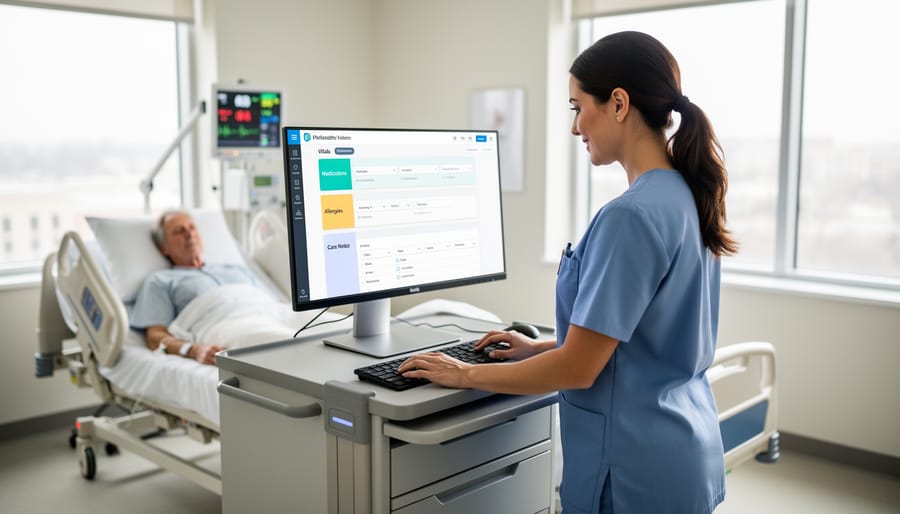
When working with electronic health records, maximize the tools available while maintaining personalized care notes. Templates save time, but customize them. Pre-populated fields work for routine assessments, but add narrative notes that capture the patient’s unique situation. One Vancouver ICU nurse notes, “I use the dropdown menus for standard assessments, but I always add a brief comment that shows I actually know my patient.”
Approved abbreviations lists exist for good reason. Stick to your facility’s approved list and spell out anything questionable. The confusion caused by non-standard abbreviations has led to medication errors and delayed treatments.
Finally, stay current. Attend annual documentation updates, review policy changes in staff meetings, and ask questions when protocols shift. Your documentation protects both patients and your professional practice.

Excellent nursing notes are a professional skill, one that develops over time with practice and intention. Like mastering a complex clinical procedure, documentation improves as you refine your technique, learn from feedback, and commit to continuous growth. The difference is that every single note you write contributes directly to patient safety and quality care.
Sarah, a nurse at a Toronto community hospital, shares her journey: “In my first year, I dreaded charting. It felt like busywork keeping me from real nursing. But after a patient’s unexpected readmission, I reviewed my notes and realized how vague they’d been. I hadn’t captured the subtle changes that might have prompted earlier intervention. That was my turning point. Now I see documentation as patient advocacy on paper.”
The shift Sarah describes is transformative. When you view documentation as an extension of clinical care rather than an administrative burden your notes become more purposeful and precise. You’re not just meeting regulatory requirements. You’re creating a roadmap that guides every team member who touches that patient’s care.
Documentation excellence contributes directly to thriving in nursing practice by strengthening your clinical reasoning and building confidence in your assessments.
Ready to take your documentation skills further? Join the Canadian Frontline Nurses community for professional development resources, peer support, and ongoing conversations about documentation excellence. Together, we’re raising the standard of nursing practice across Canada.