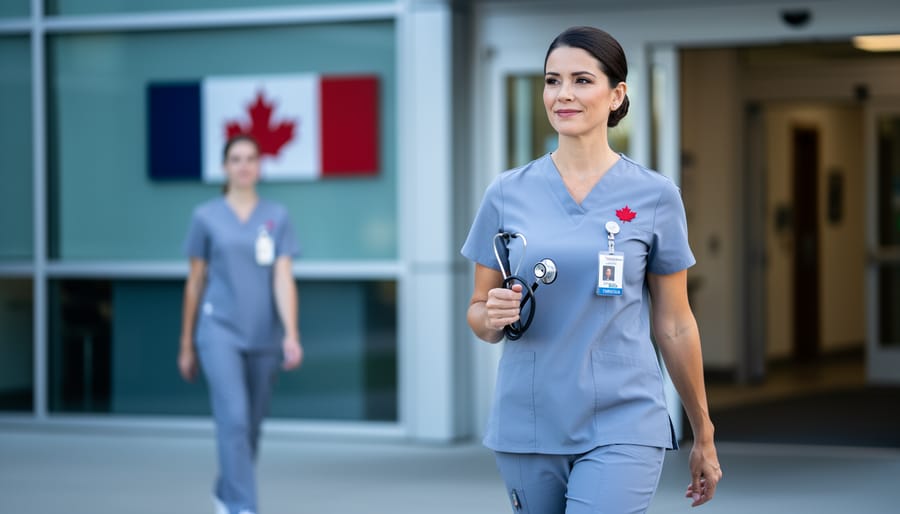
Nursing education in the United States differs from Canada’s system in three fundamental ways: entry-to-practice requirements vary by state rather than being nationally standardized, the Associate Degree in Nursing remains a common pathway alongside the Bachelor of Science in Nursing, and clinical training hours follow different protocols tied to accreditation bodies like the Commission on Collegiate Nursing Education or the Accreditation Commission for Education in Nursing.
For Canadian nurses exploring American nursing programs, whether considering cross-border education opportunities or working to understand US-trained colleagues, these structural differences shape everything from curriculum design to credential recognition. The decentralized nature of American nursing regulation means each of the 50 states sets its own licensure standards, creating a patchwork that contrasts sharply with Canada’s coordinated provincial and territorial approach under the Canadian Nurses Association framework.
Sarah Chen, a registered nurse who completed her initial education in Ontario before pursuing a specialty certification program in Boston, describes the experience as eye-opening. “The sheer variety surprised me. Two nursing schools in the same city could have completely different clinical rotations, and what counted as adequate preparation in one state wouldn’t necessarily transfer directly to another,” she explains.
Understanding the American system matters for practical reasons beyond academic curiosity. Canadian nurses may encounter employment opportunities requiring familiarity with US credentials, particularly in border communities or when collaborating with American healthcare institutions. Recognition of American nursing degrees in Canada, and vice versa, depends on meeting specific competency standards that don’t always align perfectly between the two countries’ educational models.
How US Nursing Education Differs from Canadian Programs
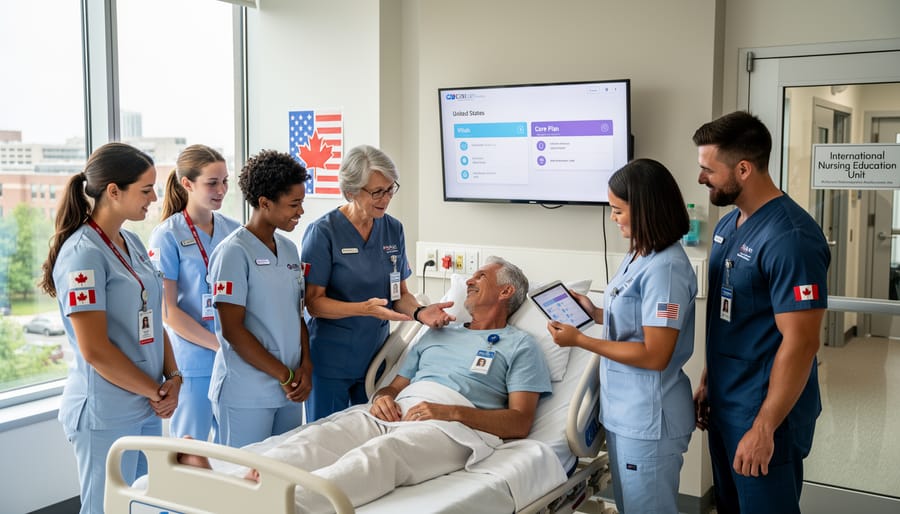
When Canadian nurses investigate US nursing education, the first surprise is often how decentralized the American system is compared to Canada’s provincially regulated but nationally consistent approach. While both countries share English as the primary language of instruction and similar healthcare delivery models, their educational frameworks diverge in structure and philosophy.
The most visible difference lies in degree pathways. The United States maintains multiple entry routes to registered nursing, including two-year Associate Degree in Nursing (ADN) programs offered through community colleges alongside four-year Bachelor of Science in Nursing (BSN) programs at universities. In contrast, Canadian nursing education has largely consolidated around baccalaureate entry, with most provinces requiring or strongly preferring a four-year BSN for new registrants. The Canadian move toward degree-only entry began in earnest during the 1990s and is now nearly universal, while the US continues to license both ADN and BSN graduates as RNs, though healthcare employers increasingly favour BSN holders.
| Aspect | USA | Canada |
|---|---|---|
| Entry-level pathways | ADN (2 years) or BSN (4 years) | BScN/BSN (4 years) standard |
| Typical program length | 2-4 years for initial RN | 4 years for baccalaureate entry |
| Primary accreditation | ACEN, CCNE (program-level) | CASN (national standards) |
| Licensure exam | NCLEX-RN | NCLEX-RN |
Accreditation structures reflect these philosophical differences. American programs seek voluntary accreditation from organizations like the Accreditation Commission for Education in Nursing (ACEN) or the Commission on Collegiate Nursing Education (CCNE), which evaluate individual programs against standards. Canada operates through the Canadian Association of Schools of Nursing (CASN), which sets national educational standards that provincial regulatory bodies then enforce. This creates more uniformity across Canadian programs, while US programs exhibit greater variation in curriculum emphasis, clinical hour requirements, and specialty focus areas.
Program length also varies more widely in the United States. ADN programs compress nursing fundamentals into intensive two-year curricula, while BSN programs spread clinical and theoretical content across four years with added emphasis on research, leadership, and public health. Canadian baccalaureate programs typically require around 120 credit hours over four years, integrating liberal arts education with nursing science. Interestingly, both countries now use the same licensure examination, the NCLEX-RN, providing a common benchmark despite educational differences.
The American Nursing Degree Landscape
Associate Degree in Nursing (ADN) vs Canadian Diploma Programs
The Associate Degree in Nursing (ADN) represents a distinct entry point into US nursing practice that differs fundamentally from Canadian program pathways. Offered primarily through community colleges, ADN programs typically span two academic years and prepare graduates to write the NCLEX-RN for registered nurse licensure. While this timeline sounds similar to Canadian diploma programs, the critical difference lies in scope and credential recognition.
Canadian RN diploma programs, though being phased out in favour of baccalaureate education, historically provided comprehensive three-year training leading directly to provincial registration. ADN graduates face increasing pressure to pursue BSN completion within the US system, as many American hospitals now require or strongly prefer bachelor’s-prepared nurses for hiring. This contrasts with Canada’s more unified approach, where diploma-prepared RNs held equivalent registration status to degree-prepared colleagues during the diploma era.
For Canadian practical nurses (LPNs/RPNs), the comparison becomes more complex, as their programs typically run one to two years but prepare graduates for a different scope of practice than US ADN-prepared RNs.
Bachelor of Science in Nursing (BSN) Programs
The Bachelor of Science in Nursing has become the gold standard for entry-to-practice in most US states, mirroring Canada’s shift toward baccalaureate education. American BSN programs typically span four years and combine liberal arts coursework with clinical nursing training, creating a broader educational foundation than the ADN pathway.
What sets US BSN programs apart is their emphasis on leadership, research, and community health from the undergraduate level. Students engage with evidence-based practice and population health concepts earlier in their training, preparing them for expanded professional roles. Many programs offer accelerated options for students who already hold a bachelor’s degree in another field, compressing nursing coursework into 12-18 intensive months.
The push toward BSN-level entry reflects employer preferences and professional standards. Major US healthcare systems, particularly those seeking Magnet designation, increasingly require or strongly prefer BSN-prepared nurses. This parallels Canadian healthcare settings that now favour or mandate baccalaureate credentials for registered nurse positions.
Canadian nurses will notice the flexibility in US BSN education. While Canadian programs follow fairly standardized provincial frameworks, American BSN curricula vary considerably between institutions, offering diverse specialization tracks and teaching approaches that reflect regional healthcare needs and institutional philosophies.
Advanced Practice and Graduate Nursing Education
Graduate nursing education in the United States follows three distinct pathways that mirror Canadian options while differing in emphasis and scope. The Master of Science in Nursing (MSN) typically requires two years of full-time study and prepares nurses for advanced practice roles like nurse practitioner, clinical nurse specialist, or nurse anesthetist, similar to Canadian nurse practitioner programs.
The Doctor of Nursing Practice (DNP) has emerged as the preferred terminal degree for clinical practice in the USA, focusing on evidence-based practice implementation and clinical leadership. This contrasts with Canada, where most advanced practice nurses hold master’s degrees, though DNP-equivalent programs are gradually appearing.
The Doctor of Philosophy (PhD) in nursing remains research-focused in both countries, preparing nurse scientists and academic faculty. Canadian nurses pursuing US graduate programs often seek specialized tracks less available domestically, particularly in areas like acute care nurse practitioner or nurse anesthesia. Both systems increasingly emphasize doctoral preparation for advanced practice, though timelines and practice scope requirements vary by jurisdiction.
Why Canadian Nurses Consider US Nursing Programs
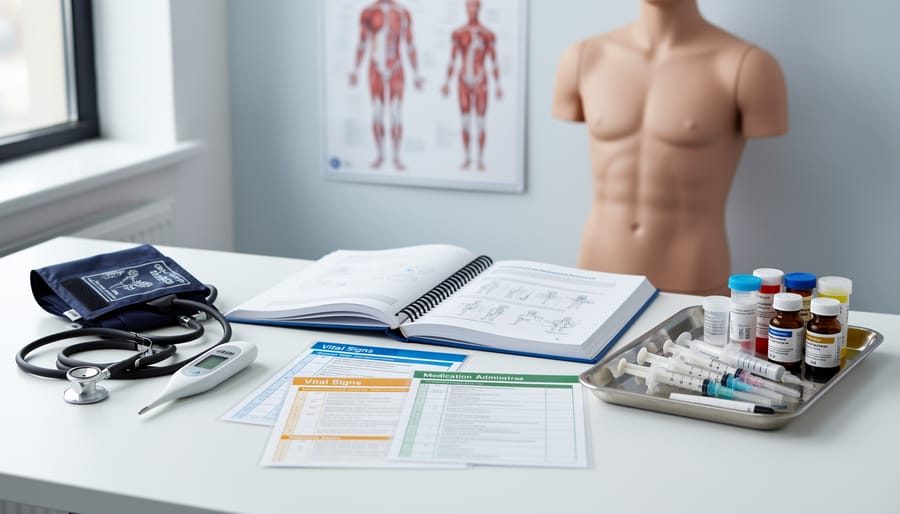
Canadian nurses explore US nursing programs for various professional and personal reasons that reflect the interconnected nature of North American healthcare systems. While Canada maintains high nursing education standards, certain specialized training opportunities and career pathways are more readily available south of the border.
Specialization depth stands out as a primary motivator. The United States offers an extensive array of certification programs and advanced practice pathways that may not exist, or have limited availability, in Canada. Nurses seeking expertise in emerging fields like forensic nursing, space medicine, or highly specialized pediatric subspecialties sometimes find more developed educational infrastructure in American institutions. The sheer number of US nursing schools creates more program options, start dates, and format flexibility than typically available in Canada’s smaller network of nursing faculties.
Geographic proximity makes US programs practical for nurses in border communities. A nurse in Windsor or Vancouver might access specialized education in Michigan or Washington State more easily than traveling across Canada. This proximity also allows some professionals to complete advanced credentials while maintaining Canadian residence and family commitments.
Career mobility factors into the decision for nurses considering cross-border practice or international healthcare roles. Familiarity with both Canadian and American nursing systems enhances professional versatility, particularly valuable for those interested in travel nursing, international health organizations, or positions with dual-country healthcare corporations. Understanding US credentialing also benefits Canadian nurse educators who teach students likely to encounter American-trained colleagues or pursue reciprocal licensure.
Financial considerations occasionally drive interest, though these cut both ways. Some American scholarships or employer-sponsored programs offer funding unavailable in Canada, while the generally higher cost of US education deters others. Exchange rates, living costs, and potential earnings post-graduation all factor into individual calculations about whether American nursing education represents a worthwhile investment in professional development.
Cross-Border Credential Recognition and Practice
One of the most significant advantages for Canadian nurses exploring US nursing education is the shared licensure examination: the NCLEX-RN. Both countries use this standardized exam to assess entry-level nursing competency, which means a nurse educated in either country has already cleared a major hurdle for cross-border practice. However, passing the NCLEX is just one piece of the credential recognition puzzle.
When a US-educated nurse wants to register in Canada, they must apply to the provincial or territorial nursing regulatory body where they intend to practice. Each jurisdiction conducts its own credential evaluation for Canada reviewing transcripts, clinical hours, and program accreditation to determine if the US education meets Canadian standards. The National Nursing Assessment Service (NNAS) streamlines this process by providing a centralized credential assessment that most provincial regulators accept, though final registration decisions rest with individual regulatory bodies. Canadian nurses considering US programs should verify that their chosen school holds proper accreditation from bodies like the Commission on Collegiate Nursing Education (CCNE) or the Accreditation Commission for Education in Nursing (ACEN), as unaccredited programs create registration complications.
The reverse pathway, Canadian-educated nurses seeking US licensure, follows a similar pattern. US state boards of nursing review Canadian transcripts and clinical hours, and graduates from Canadian Baccalaureate of Science in Nursing programs generally meet US educational requirements without difficulty. Some states require additional documentation or specific course content verification, particularly around areas like pharmacology hours or psychiatric nursing clinical time, which can vary between programs.
Understanding these credential pathways from education to registration matters because it affects career planning and professional mobility. A nurse who completes a BSN in Texas and later wants to practice in Ontario faces the same rigorous registration process as any internationally educated nurse, including possible bridging requirements. Similarly, scope of practice boundaries differ between jurisdictions even after registration, meaning the clinical activities you’re authorized to perform can shift across the border.
For nurses pursuing advanced practice roles, credential recognition becomes more complex. Nurse practitioner credentials, for instance, face additional scrutiny because NP practice varies substantially between Canadian provinces and US states in terms of autonomy, prescriptive authority, and collaborative practice requirements.
A Canadian Nurse’s Story: Bridging Two Systems
Sarah Chen graduated from a Toronto nursing program in 2019 and spent three years working in medical-surgical units across the GTA. When she decided to pursue critical care certification, an opportunity emerged that she hadn’t initially considered: a specialized acute care nurse practitioner program at Johns Hopkins in Baltimore.
“I was hesitant at first,” Sarah recalls. “Leaving my job, navigating the visa process, and adapting to a different healthcare system felt overwhelming. But the program offered training in advanced hemodynamic monitoring techniques that weren’t as readily available in Canada at the time.”
The application process required credential evaluation through CGFNS International to verify her Canadian BSN met US standards. Sarah obtained an F-1 student visa, which limited her ability to work during the program but allowed clinical placements within the university hospital system.
The educational approach differed significantly from her Canadian training. “The US program emphasized autonomous decision-making and diagnostic reasoning earlier in the curriculum,” she explains. “We had more exposure to ordering and interpreting diagnostic tests, which expanded my clinical thinking.” The simulation labs featured high-fidelity scenarios with actual medical equipment brands common in both countries, providing practical skills that translated across borders.
Cultural adjustments extended beyond academics. American healthcare’s insurance-driven model shaped clinical discussions differently than Canada’s single-payer context. “Understanding prior authorizations and coverage limitations became part of patient assessment in ways I hadn’t experienced before,” Sarah notes.
After completing her degree in 2023, Sarah returned to Toronto, where her credentials required evaluation by the College of Nurses of Ontario. Her US professional education was recognized, though she needed to demonstrate equivalent Canadian practice hours before obtaining her nurse practitioner designation.
Today, Sarah works in a cardiac ICU, where the advanced assessment skills and evidence-based protocols from her US training inform her daily practice. “The experience gave me a broader perspective on nursing excellence,” she reflects. “Both systems have strengths, and understanding both made me a better clinician.”
What Canadian Nurses Can Learn from US Nursing Education Trends
Simulation and Technology Integration
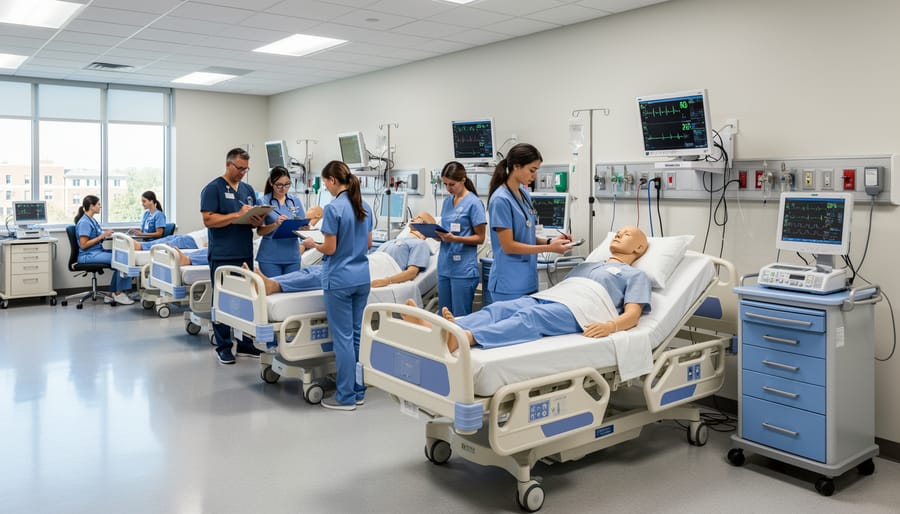
US nursing programs have made substantial investments in simulation technology that Canadian nurses can observe as a model for technology-enhanced learning. High-fidelity mannequins that breathe, bleed, and respond to interventions now populate simulation labs across American nursing schools, allowing students to practice complex scenarios from cardiac arrests to obstetric emergencies in controlled environments before encountering real patients.
Virtual reality platforms are gaining traction in US programs, enabling students to navigate 3D hospital environments, practice sterile techniques, and develop spatial awareness skills. Some schools use VR headsets to simulate rare clinical situations, anaphylaxis, stroke assessment, pediatric trauma, that students might not encounter during traditional clinical rotations.
American programs are also integrating artificial intelligence-powered platforms that adapt scenarios based on student decisions, creating personalized learning experiences. These systems track performance metrics, identify knowledge gaps, and provide immediate feedback that instructors can use to target remediation.
The emphasis on simulation reflects both practical constraints, limited clinical placement sites, and pedagogical benefits. Students can make mistakes, repeat procedures, and build confidence without patient safety risks. For Canadian nurses considering professional development, understanding these technology trends offers perspective on where nursing education is heading and how simulation competencies are becoming standard expectations in modern practice.
Specialized Certification Pathways
The US nursing certification landscape offers an extensive array of specialized credentials that often exceed what’s typically available through Canadian certification pathways. American nurses can pursue certifications in highly specific clinical niches, from certified wound, ostomy, and continence nurses (CWOCN) to certified pediatric emergency nurses (CPEN), through organizations like the American Nurses Credentialing Center (ANCC) and specialty nursing associations.
What sets the American system apart is the sheer volume of micro-specializations. You’ll find certifications for everything from diabetes education and bariatric nursing to forensic nursing and flight nursing. Many US hospitals structure career ladders around these credentials, offering salary increases and advancement opportunities tied directly to certification attainment.
The certification pathways themselves differ structurally. While Canadian certification typically requires a combination of practice hours and examination, US programs often bundle certification preparation into formal continuing education courses, creating clearer learning pathways. Some US employers even provide paid time and financial support specifically for certification study, recognizing these credentials as essential workforce development.
Canadian nurses exploring these options should note that many American certifications require US licensure or specific practice hours within the American healthcare system. However, the knowledge gained from understanding these specialized pathways can inform career planning in Canada, particularly as our healthcare system continues expanding recognition of specialized practice roles and considering similar certification structures for emerging specialties.
Practical Considerations for Canadian Nurses Exploring US Education

Pursuing nursing education in the USA requires careful evaluation of practical factors that extend well beyond academic fit. Canadian nurses considering American programs need to weigh financial realities, immigration requirements, and how this decision impacts their long-term career trajectory at home.
The financial investment demands honest assessment. Consider these key factors:
- Tuition at US nursing programs typically ranges from $15,000 to $50,000 USD annually, with international students rarely qualifying for federal financial aid or in-state tuition rates
- F-1 student visas require proof of sufficient funds to cover tuition and living expenses for the entire program duration before approval
- Additional costs include mandatory health insurance, housing in often-expensive university towns, and potential currency exchange losses
- Time away from the Canadian workforce means lost income and CPP contributions, plus potential gaps in provincial registration
- Post-graduation work authorization through Optional Practical Training (OPT) is limited and doesn’t guarantee long-term US practice rights
The visa process itself takes three to six months and requires acceptance to a SEVP-certified program before you can even apply. You’ll need to demonstrate non-immigrant intent, proving you plan to return to Canada, while simultaneously investing years in American education, a contradiction that requires careful documentation.
Career implications deserve equal attention. Will your provincial nursing college recognize the specific US credential you’re pursuing? Some provinces scrutinize clinical hour requirements and course content, particularly for specialized programs. The choice between thriving vs burned-out often hinges on sustainable career decisions that align with your actual practice goals rather than pursuing credentials for their own sake.
Ask whether the specialization or training you seek truly requires US education, or if Canadian programs, continuing education certificates, or mentorship arrangements could achieve similar outcomes without the complexity and cost of cross-border study.
Understanding the American nursing education system offers Canadian nurses valuable perspective on the diversity of pathways available within our shared profession. While our systems evolved differently, shaped by distinct healthcare structures and regulatory frameworks, both prioritize preparing competent, compassionate practitioners who advance patient care through evidence-based practice.
The comparative insights gained from exploring US nursing education extend beyond academic curiosity. They illuminate alternative approaches to specialization, innovative teaching methodologies, and emerging practice roles that can inform your professional development decisions right here in Canada. Whether you’re considering additional credentials, exploring new specialties, or simply broadening your understanding of colleagues trained across the border, this knowledge strengthens your professional foundation.
Cross-border awareness also prepares you for the increasingly interconnected nature of healthcare delivery. Canadian nurses regularly collaborate with US-educated colleagues, engage with American research and clinical guidelines, and contribute to North American nursing discourse that shapes practice standards on both sides of the border.
At Canadian Frontline Nurses, we believe informed professionals make stronger advocates for themselves and their patients. Explore our resources on continuing education pathways, specialty certifications, and professional development opportunities designed specifically for Canadian nursing contexts. Join our community to connect with nurses navigating similar career questions and share experiences that elevate our profession collectively.