
The AACN’s Four Spheres of Care framework defines the interconnected areas where nurses and healthcare professionals invest their energy and expertise: the patient or family, the nursing team, the hospital or health system, and the broader profession itself. Rather than viewing these as competing priorities, the model recognizes that sustainable, high-quality care depends on attention to all four domains working in balance.
For Canadian nurses navigating complex healthcare environments in 2026, this framework offers a practical lens for understanding why professional wellbeing matters as much as bedside competence. When a nurse mentors a colleague, advocates for evidence-based policy changes, or participates in professional development, they’re not stepping away from patient care. They’re strengthening the systems that make excellent patient outcomes possible.
This framework emerged from the American Association of Critical-Care Nurses but has found resonance across Canadian practice settings because it names something nurses already know: caring for patients well requires caring for the people and structures that support them. A nurse who feels supported by their team, empowered by their organization, and connected to the nursing profession brings different energy to the bedside than one who feels isolated or depleted.
Understanding the Four Spheres helps Canadian nurses articulate why collaboration across disciplines matters, why healthy work environments aren’t optional extras, and how individual practice connects to system-level change. This article breaks down each sphere, explains how they interact in daily practice, and shows how this framework supports the kind of nursing culture that retains skilled professionals and delivers consistent patient safety.
What the AACN 4 Spheres of Care Framework Means
The AACN 4 Spheres of Care framework emerged from the American Association of Critical-Care Nurses as a holistic model recognizing that exceptional nursing care extends beyond bedside clinical skills. While developed in the United States, Canadian nurses have embraced this framework because it aligns naturally with the patient-centered, collaborative values embedded in Canadian healthcare practice. The model acknowledges that nurses simultaneously operate across four interconnected domains: caring for patients, supporting families and communities, strengthening the nursing team, and improving healthcare systems.
At its core, this framework challenges the narrow view of nursing as solely patient-focused work. Instead, it positions nurses as professionals who balance direct care responsibilities with relationship building, peer collaboration, and systemic advocacy. Each sphere influences the others, when nurses support colleagues effectively, patient care improves; when families receive adequate education and resources, clinical outcomes strengthen.
- Sphere of Care
- A distinct domain of nursing responsibility that encompasses specific relationships, activities, and outcomes within the broader practice environment.
- Holistic Nursing Practice
- An approach that addresses the complete ecosystem of healthcare delivery, recognizing that patient outcomes depend on factors well beyond individual clinical interventions.
- Collaborative Care Model
- A framework emphasizing interdependent relationships among patients, families, healthcare teams, and systems rather than isolated provider-patient interactions.
Canadian nurses find particular value in how the framework honors the realities of provincial healthcare systems, rural and remote practice challenges, and the collaborative culture that defines Canadian nursing. Rather than prescribing rigid protocols, the 4 Spheres offer a flexible lens for understanding where nurses invest their energy and how those investments interconnect. This adaptability makes the model relevant whether you’re working in a major urban trauma center, a community clinic in Northern Ontario, or a long-term care facility in rural Saskatchewan.
The Four Spheres Explained: Components of Holistic Nursing Care
Sphere 1: Patient Care

Sphere 1 centers on the nurse-patient relationship and direct clinical interventions. This sphere demands rigorous assessment skills, clinical judgment, and adherence to evidence-based protocols that align with patient-centered care standards recognized across Canadian healthcare. Nurses apply the nursing process, assessment, diagnosis, planning, implementation, evaluation, while respecting patient autonomy and cultural preferences.
In Canadian practice, this sphere requires fluency with provincial standards of care, national competency frameworks, and evolving clinical guidelines. Critical-care nurses, for instance, integrate advanced monitoring, medication management, and family communication within high-acuity environments. Community nurses adapt the same patient-centered principles to home visits and chronic disease management. The sphere’s strength lies in individualized care: recognizing each patient’s unique context, values, and goals rather than applying one-size-fits-all interventions. This focus on personalized, evidence-informed practice forms the foundation upon which the other three spheres build.
Sphere 2: Family and Community

This sphere extends care beyond the individual patient to encompass families, caregivers, and the broader community networks that shape health outcomes. Canadian nurses recognize that healing and health maintenance rarely occur in isolation, they’re influenced by family dynamics, cultural contexts, and access to community resources.
In practice, this means actively engaging families in care decisions, providing caregiver education, and connecting patients with appropriate community supports. The sphere takes on heightened importance in rural and remote Canadian settings, where nurses often serve as primary healthcare coordinators, linking isolated patients with distant specialists, arranging telehealth services, and mobilizing limited local resources.
Indigenous health services particularly exemplify this sphere’s application, as nurses collaborate with Elders, family members, and community health representatives to deliver culturally safe care that respects traditional healing practices alongside conventional medicine. Effective work within this sphere requires strong communication skills, cultural humility, and knowledge of provincial and territorial community health resources, from home care programs to mental health supports, that enable patients to thrive beyond hospital walls.
Sphere 3: Nursing Team and Colleagues
The third sphere centers on the relationships and dynamics within your immediate nursing team and the broader professional community. This sphere recognizes that quality patient care depends on healthy, functional teams where nurses support one another through knowledge sharing, mutual respect, and collaborative decision-making.
In Canadian contexts, this sphere takes on particular importance given our diverse healthcare landscape. Nurses working across different provinces, practice settings, and specialties face unique challenges, from staffing pressures to regulatory variations, that require strong collegial bonds. When you invest in this sphere, you’re contributing to peer mentorship, interprofessional teamwork, and the kind of workplace culture that reduces burnout and keeps experienced nurses in practice.
This sphere also encompasses your role in building bridges between nursing and other disciplines, respiratory therapy, pharmacy, social work, and medicine, creating the collaborative environment essential to Canada’s publicly funded system. By strengthening these professional relationships, you enhance both individual resilience and collective capacity to deliver excellent care across all settings.
Sphere 4: Healthcare System and Organization
The fourth sphere positions nurses as active participants in shaping the healthcare systems they work within. Rather than passive recipients of organizational policies, nurses contribute to quality improvement initiatives, participate in workplace safety committees, and advocate for changes that affect both patient care and working conditions.
At the provincial level, this sphere connects to engagement with nursing regulatory bodies, participation in policy consultations, and involvement in professional associations that advocate for healthcare funding and staffing standards. Nurses might identify gaps in current protocols, propose evidence-based practice changes, or collaborate on system-wide initiatives to reduce medication errors or improve patient flow.
At the organizational level, this work includes participating in hospital committees, contributing to accreditation processes, and helping develop institutional policies that reflect frontline realities. The sphere recognizes that system-level improvements, whether addressing nurse-to-patient ratios, securing adequate resources, or refining discharge planning processes, directly impact all other spheres of care.
This systemic perspective complements the direct care focus of earlier spheres, acknowledging that sustainable improvements require nurses who understand and actively shape the structures surrounding patient care delivery across Canada’s diverse healthcare environments.
How the 4 Spheres Work in Canadian Nursing Practice
Canadian nurses integrate the 4 Spheres of Care into daily practice through a systematic yet flexible approach that balances immediate clinical needs with broader professional responsibilities. Rather than treating the spheres as separate tasks, experienced nurses weave them together through intentional attention and cyclical reflection.
The framework begins with assessment that extends beyond the patient’s immediate physical condition. A nurse entering a shift considers not just vital signs and treatment plans, but also family dynamics, team communication patterns, and systemic factors affecting care delivery. This multi-sphere awareness shapes clinical decision-making: recognizing when a patient’s anxiety stems from inadequate family support, noticing when team fatigue might compromise safety, or identifying systemic barriers that delay essential interventions.
Care planning across spheres happens both formally and informally throughout each shift. Documentation captures patient-centered goals while simultaneously noting family education needs, peer collaboration points, and resource gaps requiring policy advocacy. Many nurses develop personal strategies to maintain sphere balance:
- Start-of-shift check-ins with colleagues to assess team dynamics and support needs
- Scheduled family communication windows to maintain the family sphere when direct care demands are high
- Brief end-of-shift reflection on which spheres received attention and which require focus tomorrow
- Monthly review of system-level concerns to identify opportunities for collective advocacy
- Peer debriefing sessions that strengthen the nursing team sphere while processing challenging cases
The 4 Spheres align naturally with Canadian nursing competencies outlined by provincial regulatory bodies. The CNA Competencies Framework and provincial standards already emphasize holistic care, professional relationships, and systems thinking, concepts the 4 Spheres organize into actionable daily practice. Nurses working within these standards find the framework reinforces rather than contradicts existing professional expectations, offering a mental model that makes comprehensive care feel manageable rather than overwhelming. The key is recognizing that excellence in one sphere often supports the others: strong team collaboration improves patient outcomes, systemic improvements reduce family stress, and patient-centered care strengthens professional satisfaction.
Applications: Where Canadian Nurses Use the 4 Spheres Model
Canadian nurses apply the 4 Spheres of Care framework across diverse healthcare environments, adapting it to meet the unique demands of each setting while maintaining its holistic approach.
In critical care units, nurses balance immediate patient needs with family communication and team coordination during high-stress situations. The framework guides rapid clinical decisions (Sphere 1) while maintaining awareness of family anxiety levels (Sphere 2), supporting colleagues through difficult cases (Sphere 3), and advocating for adequate staffing ratios (Sphere 4). Nursing documentation in these settings captures assessments across all spheres, creating comprehensive records that protect both patients and practitioners.
Community health nurses use the framework to address social determinants of health. They provide direct care (Sphere 1), connect clients with community resources and family supports (Sphere 2), collaborate with public health teams (Sphere 3), and identify gaps in services that require systemic attention (Sphere 4). This approach is particularly effective when working with vulnerable populations who need coordinated care beyond clinical interventions.
Long-term care settings demonstrate the framework’s value in relationship-centred care. Nurses build ongoing therapeutic relationships with residents, engage families as care partners, foster supportive team environments, and advocate for quality-of-life improvements within organizational constraints. The emphasis on Sphere 3 helps teams avoid burnout through peer support during emotionally demanding work.
Nurses serving Indigenous communities adapt the framework by incorporating traditional healing practices (Sphere 1), respecting kinship networks and Elder involvement (Sphere 2), collaborating with community health representatives (Sphere 3), and addressing jurisdictional barriers in service delivery (Sphere 4).
Remote nursing positions particularly benefit from the systems-level thinking the framework promotes. Isolated practitioners manage all four spheres simultaneously, often serving as the only healthcare provider, family educator, peer mentor via telehealth connections, and advocate for resource allocation across vast geographic areas.
Building Collaboration and Unity Through the Spheres
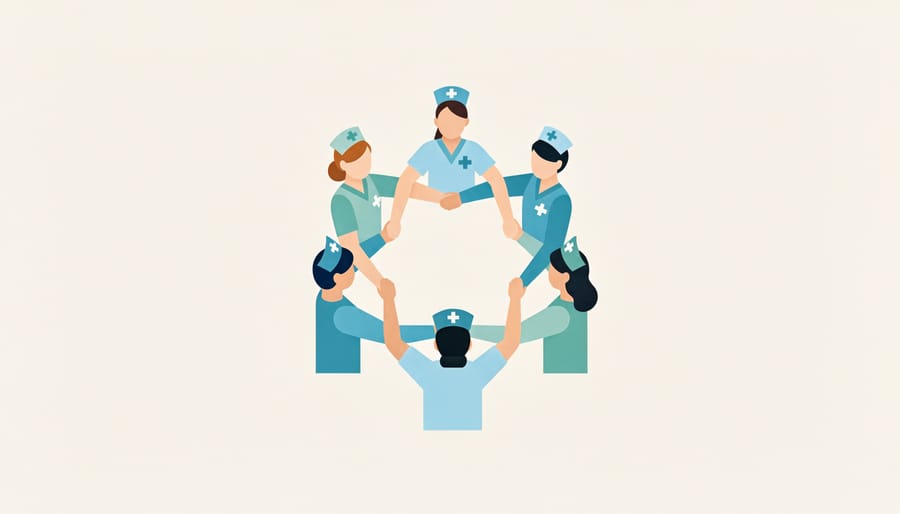
The Nursing Team sphere transforms abstract ideals about teamwork into concrete practice, creating environments where Canadian nurses actively support one another across shifts, specialties, and provinces. This sphere recognizes that isolated practitioners cannot deliver the comprehensive care patients need; collaboration becomes both a professional responsibility and a daily necessity.
Peer mentorship thrives under this framework. Experienced nurses share clinical wisdom and emotional coping strategies with newer colleagues, reducing burnout and accelerating skill development. Collaboration and communication strengthen when teams establish regular huddles, debrief sessions after complex cases, and transparent decision-making processes. Interdisciplinary partnerships expand the sphere’s reach, nurses work alongside physicians, social workers, respiratory therapists, and pharmacists, each contributing specialized knowledge while respecting others’ expertise.
Shared governance opportunities embed nurses’ voices in unit-level decisions about staffing patterns, equipment purchases, and care protocols. When frontline staff help shape policies they will implement, buy-in increases and solutions better reflect ground-truth realities. Professional community building extends beyond individual units: provincial nursing associations, specialty interest groups, and informal networks connect nurses facing similar challenges, whether managing rural isolation, navigating bilingual care requirements, or advocating for safer working conditions.
This sphere directly counters the fragmentation that weakens healthcare teams. By prioritizing mutual support, open communication, and collective problem-solving, the Nursing Team sphere builds the unity necessary for both individual resilience and systemic improvement. The framework gives nurses permission to invest time in relationships that ultimately enhance every other sphere’s effectiveness.
Common Questions About the AACN 4 Spheres in Canadian Practice
Canadian nurses often have practical questions about how to integrate the 4 Spheres framework into their daily work, especially when their facilities don’t formally recognize the model or when they face competing demands across multiple spheres.
Can I apply the 4 Spheres framework if my workplace doesn’t formally use it?
Yes, the framework serves as a mental model for organizing your practice regardless of whether your facility has adopted it officially. You can use it as a personal reflection tool to ensure you’re addressing patient needs, supporting families, collaborating with colleagues, and contributing to system improvements within your scope.
How do I balance competing priorities when all four spheres demand attention?
Balance doesn’t mean equal time in each sphere simultaneously; it means recognizing which sphere requires immediate focus while maintaining awareness of the others. During a critical patient event, direct care takes precedence, but during quieter moments you might mentor a colleague or contribute to a quality improvement discussion.
Is the 4 Spheres model relevant outside critical care settings?
Absolutely. While developed by the American Association of Critical-Care Nurses, the holistic principles apply across all nursing specialties, community health, long-term care, mental health, and primary care all benefit from attending to patients, families, teams, and systems.
Where can Canadian nurses find training or resources on this framework?
Provincial nursing associations, continuing education programs, and professional development workshops sometimes incorporate spheres-of-care concepts into leadership or practice excellence curricula. Exploring literature on holistic nursing models and collaborative practice frameworks can also deepen your understanding.
Understanding that the framework adapts to your unique practice context makes it more accessible. Nurses in remote settings might emphasize community engagement and system advocacy, while those in urban teaching hospitals may focus heavily on team collaboration and evidence implementation. The model’s flexibility allows you to strengthen whichever spheres most need attention in your current role while building capacity in others over time.
The 4 Spheres of Care framework offers Canadian nurses more than a clinical model, it provides a unifying structure that strengthens both patient outcomes and the nursing community itself. By attending to patients, families, colleagues, and the broader healthcare system simultaneously, nurses create care environments where excellence and collaboration reinforce each other.
This holistic lens reminds us that nursing practice never happens in isolation. When we support our peers, engage families as partners, and advocate for systemic improvements, we’re not just checking boxes. We’re building the interconnected professional community that makes sustained, high-quality care possible across every province and territory.
Consider where you stand within each sphere today. Which areas feel strong in your practice? Where could deeper engagement make a difference, for your patients, your team, or yourself? The framework isn’t prescriptive; it’s reflective, inviting you to examine your practice through a wider angle.
Professional development opportunities through provincial nursing associations, continuing education programs, and workplace mentorship initiatives can help you strengthen your approach across all four spheres. Connecting with colleagues who share this commitment builds the collaborative culture Canadian healthcare needs.