
Canadian nursing programs provide structured pathways to enter one of the country’s most respected and in-demand professions, typically requiring two to four years of study depending on whether you pursue a diploma, a Bachelor of Science in Nursing (BScN), or an accelerated second-degree program. The journey from education to registration combines rigorous classroom learning with hands-on clinical placements, preparing you to deliver compassionate, evidence-based care across diverse healthcare settings.
Right now, Canada faces a significant nursing shortage, with healthcare systems across provinces actively recruiting new graduates. This reality translates into strong employment prospects, but it also means nursing programs maintain competitive admission standards. You’ll need solid academic prerequisites, often including biology, chemistry, and English, along with a genuine commitment to patient care.
What sets Canadian nursing education apart is its emphasis on clinical competency from day one. Students spend substantial time in hospitals, long-term care facilities, and community health centres, working alongside experienced nurses who model professional practice. These placements aren’t just observation; you’ll be providing direct patient care under supervision, building the confidence and skills that make newly graduated nurses employment-ready.
Meet Sarah Chen, a recent BScN graduate from Vancouver who completed her program while raising two young children. “The clinical rotations challenged me in ways I never expected,” she recalls, “but they also showed me I could handle the real pressure of nursing. That hands-on experience made all the difference when I started my first job in emergency.”
Whether you’re fresh out of high school, switching careers, or already working as a practical nurse seeking advancement, understanding your program options is the critical first step.
Understanding Canadian Nursing Program Types
Canada offers several distinct pathways into nursing, each designed for different starting points and career goals. Whether you’re a high school graduate, a career changer with a previous degree, or a registered nurse seeking advanced credentials, there’s a program structured to meet your needs.
The landscape of Canadian nursing education includes four main categories. Practical nursing programs prepare Licensed Practical Nurses (LPNs) or Registered Practical Nurses (RPNs, depending on the province) who provide direct patient care under the supervision of registered nurses or physicians. Bachelor of Science in Nursing (BScN) programs are the standard university degree for becoming a Registered Nurse (RN), offering comprehensive education in nursing theory, research, and clinical practice. Accelerated second-entry programs compress the BScN curriculum into an intensive format for applicants who already hold a bachelor’s degree in another field. Graduate programs, master’s degrees, nurse practitioner certificates, and doctoral studies, build advanced expertise for RNs pursuing leadership, specialized clinical roles, education, or research careers.
- Practical Nursing (PN) Diploma
- Two-year college programs preparing graduates to work as Licensed Practical Nurses (LPNs) or Registered Practical Nurses (RPNs), providing direct bedside care, medication administration, and patient monitoring under RN supervision. Graduates work in hospitals, long-term care facilities, community health, and home care settings.
- Bachelor of Science in Nursing (BScN)
- Four-year university degree programs that educate Registered Nurses with comprehensive training in nursing science, critical thinking, health assessment, and autonomous practice. BScN graduates can work in all healthcare settings and pursue specialty certifications or graduate education.
- Accelerated BScN
- Intensive 18-24 month programs designed for students who already hold a bachelor’s degree in any field, condensing the standard BScN curriculum while leveraging prior university-level learning. These fast-track programs lead to the same RN credential and career opportunities as traditional four-year programs.
- Master of Nursing
- Graduate programs (typically two years full-time) for RNs seeking advanced practice roles, leadership positions, nursing education careers, or specialized clinical expertise in areas like oncology, mental health, or pediatrics. Many programs include nurse practitioner preparation or research thesis components.
- Nurse Practitioner (NP) Programs
- Specialized master’s or post-master’s certificates that prepare RNs to diagnose conditions, order tests, prescribe medications, and manage patient care with greater autonomy in primary care, acute care, or specialty settings. NPs require additional provincial registration beyond RN licensure.
- Doctor of Philosophy (PhD) in Nursing
- Research-focused doctoral programs preparing nurse scholars, researchers, and academic leaders who advance nursing knowledge, conduct health services research, and shape healthcare policy. PhD-prepared nurses typically work in universities, research institutes, or senior healthcare leadership roles.
Your choice among these pathways depends on your current education level, time availability, financial resources, and long-term career vision. Practical nursing offers the quickest entry to patient care, while BScN programs provide broader scope and advancement potential. Graduate studies open doors to specialized practice, leadership, and academia. Each pathway is valuable and addresses critical needs within Canada’s healthcare system.
Entry Requirements and Prerequisites
Getting into a Canadian nursing program starts well before you submit your application. Most schools set clear academic benchmarks and expect you to demonstrate both preparation and commitment to healthcare.
For high school students applying to Bachelor of Science in Nursing programs, you’ll typically need Grade 12 biology, chemistry, and English with minimum averages ranging from 70% to 85%, depending on the institution’s competitiveness. Math is often required as well. Practical nursing diploma programs generally have slightly lower grade thresholds, around 65% to 75%, and may accept mature students who completed high school years ago or who hold equivalency certificates.
Many programs now require or strongly recommend healthcare-related volunteer or paid experience before admission. This might mean 40 to 100 hours in hospitals, long-term care facilities, or community health settings. Schools want evidence that you understand what nursing involves and have tested your interest in patient care. Some institutions ask for written reflections on these experiences as part of the application.
International students and applicants whose first language isn’t English or French must prove language proficiency through tests like IELTS (commonly 6.5 to 7.0 overall) or TOEFL iBT (typically 83 to 100). French-language programs have equivalent requirements for French proficiency.
Before starting clinical placements, you’ll need up-to-date immunizations including hepatitis B, MMR, varicella, and annual flu shots. Most schools require proof before you can begin. A clear criminal record check with vulnerable sector screening is mandatory, as is current CPR certification in many programs.
Accelerated second-entry BScN programs have distinct requirements: you must hold a bachelor’s degree in any field with a competitive GPA, usually 3.0 or higher, and complete any missing science prerequisites. These condensed programs attract career-changers who already have university-level study skills and life experience.
How Canadian Nursing Programs Work
Clinical Placements and Practice Experience
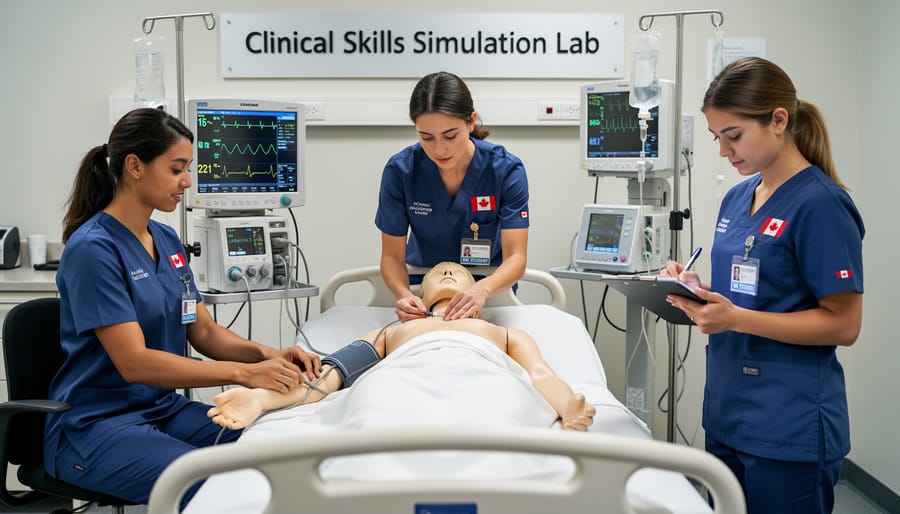
Clinical placements form the cornerstone of nursing education in Canada, bridging theoretical knowledge with real-world patient care. Most programs dedicate 40-50% of total study time to hands-on clinical practice, beginning in the second semester and intensifying as students progress.
Schools coordinate placements through agreements with partner healthcare facilities. Students typically rotate through diverse settings: acute care hospital units (medical-surgical, pediatrics, intensive care), community health centres, long-term care facilities, mental health services, and public health agencies. These rotations ensure exposure to varied patient populations and care contexts, from administering medications in hospital wards to conducting home visits with community nurses.
Each placement pairs students with experienced nurses called preceptors who guide, observe, and evaluate their performance. Preceptors model professional practice, answer questions in real time, and gradually increase student responsibilities as competence develops. Students might start by taking vital signs and assisting with hygiene care, then advance to complex skills like wound care, IV therapy, and comprehensive patient assessments.
The clinical environment demands immediate application of classroom learning. Students must synthesize pathophysiology, pharmacology, and nursing documentation standards while managing the emotional demands of direct patient interaction. They learn to prioritize competing needs, communicate with interdisciplinary teams, and make clinical judgments under supervision.
Most programs require students to maintain clinical logbooks documenting procedures performed and competencies achieved. Successful completion of all clinical hours and competency evaluations is mandatory for graduation, there are no substitutes for this hands-on experience.
Program Duration and Time Commitment
Program timelines vary significantly depending on your chosen nursing pathway and whether you study full-time or part-time. Practical nursing (LPN/RPN) diploma programs typically run two years full-time, combining classroom instruction with clinical rotations across four semesters. If you’re pursuing a Bachelor of Science in Nursing (BScN) through a standard university program, expect a four-year commitment with eight semesters of study.
Already hold a bachelor’s degree in another field? Accelerated second-entry programs compress the BScN curriculum into an intensive 20 to 24 months, often with year-round study and limited breaks. The UPEI accelerated program length reflects this condensed timeline, requiring full-time attendance and a demanding schedule that leaves little room for outside employment.
Graduate nursing programs show even wider variation. Master’s programs generally take two to three years full-time, while Nurse Practitioner streams may require two years of intense coursework and clinical practica. Doctoral programs (PhD in Nursing) demand three to five years depending on your research focus and progression.
Part-time options exist at some institutions, particularly for working RNs pursuing graduate degrees, but they extend timelines considerably and aren’t widely available for entry-level programs due to clinical scheduling requirements. Most nursing schools structure clinical placements during daytime hours, making full-time enrollment the practical choice for the majority of students starting their nursing education.
Accreditation and Regulatory Standards
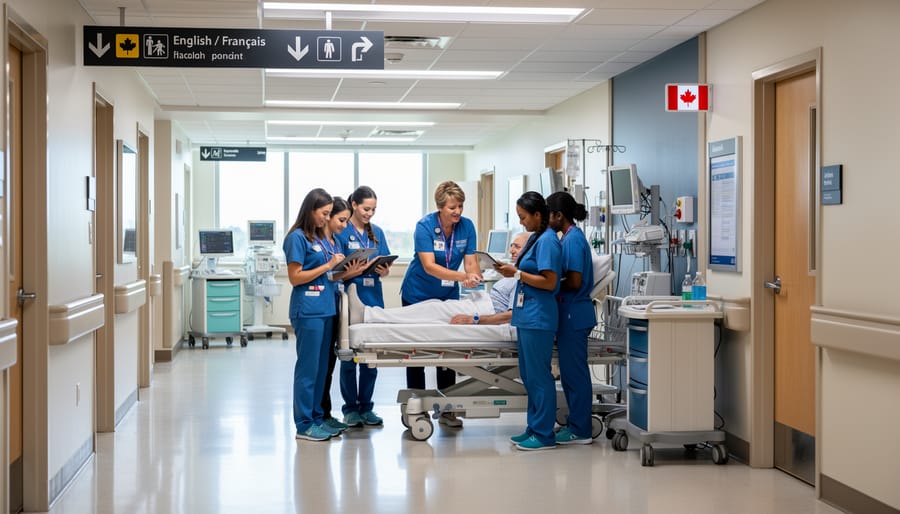
Accreditation ensures that nursing programs meet rigorous national standards for curriculum, faculty qualifications, clinical resources, and student outcomes. In Canada, the Canadian Association of Schools of Nursing (CASN) operates the accreditation framework for baccalaureate and graduate nursing programs, conducting comprehensive reviews every seven years to verify that schools maintain educational excellence and prepare graduates for safe, competent practice. Provincial regulatory bodies, such as the College of Nurses of Ontario (CNO) and the College of Registered Nurses of British Columbia (CRNBC), also approve nursing programs within their jurisdictions, ensuring compliance with provincial standards and regulations.
Attending an accredited or approved program isn’t just about quality; it’s a prerequisite for your nursing career.
If you complete a program that lacks proper accreditation or provincial approval, you won’t be able to sit for the NCLEX-RN (the licensing exam for registered nurses) or the practical nursing exam required in your province. This makes verifying a program’s accreditation status essential before you apply, check the school’s website for CASN accreditation and confirm approval with your provincial regulatory college.
After graduation, you must pass the appropriate licensing examination to practice. Registered nurse candidates write the NCLEX-RN, a computerized adaptive test that assesses clinical judgment and nursing knowledge. Practical nursing graduates take provincial exams such as the Canadian Practical Nurse Registration Examination (CPNRE). These exams, combined with your approved program credentials, form the gateway to provincial registration and your nursing license. Accreditation and regulatory oversight work together to protect the public, maintain professional standards, and ensure that every nurse entering practice has met consistent, verifiable benchmarks for competence.
Choosing the Right Nursing Program
Selecting a nursing program is one of the most significant decisions in your journey to becoming a nurse, and it deserves careful consideration beyond simply choosing the nearest school. Start by confirming that any program you’re considering holds accreditation from the Canadian Association of Schools of Nursing (CASN) and approval from your provincial regulatory body, without this, you won’t be eligible for licensure, regardless of how much effort you put into your studies.
Clinical placement quality matters enormously. Look for programs with strong partnerships across multiple healthcare settings, teaching hospitals, community health centres, mental health facilities, and long-term care homes. The breadth of your clinical experiences directly shapes your competence and confidence as a new graduate. Ask admissions representatives which sites students rotate through and whether you’ll have opportunities in specialty areas that interest you.
Program reputation extends beyond marketing materials. Research NCLEX pass rates for the past three years; programs consistently achieving rates above 85% demonstrate solid curriculum and student preparation. Check graduate employment rates within six months of completion. Connect with recent alumni through LinkedIn or nursing forums to ask about their experiences with faculty support, clinical coordination, and job readiness.
Class size influences your learning experience. Smaller cohorts often mean more individualized attention from instructors and easier access to simulation lab time, though larger programs may offer broader elective options and more extensive alumni networks. Consider what learning environment helps you thrive.
Location affects both your education and personal life. Programs close to home reduce relocation costs and maintain your support network, but moving to a different city might offer stronger clinical opportunities or specialized tracks unavailable locally. Factor in commute times to clinical sites, which can start as early as 6:30 a.m.
Cost varies significantly, from approximately $6,000 annually at some colleges to over $30,000 at certain universities. Weigh tuition against available scholarships, bursaries, and whether the program offers co-op terms that let you earn while learning. Don’t forget additional expenses: textbooks, uniforms, clinical supplies, parking, and potentially relocating for rural placements.
Program flexibility matters if you’re balancing work, family, or other commitments. Some schools offer part-time tracks, evening classes, or bridging programs for internationally educated nurses or those with previous healthcare credentials. Accelerated second-entry programs compress a BScN into 20-24 months for those holding prior degrees, though the intensity demands full-time dedication.
Support services can make or break your success. Investigate what’s available: peer mentorship programs, tutoring centres, mental health counselling, simulation lab access outside class hours, and career services. Programs serving diverse student populations should offer targeted supports for Indigenous students, newcomers, mature students, and those with disabilities.
Finally, align your choice with your career aspirations. If you’re drawn to advanced practice, a university BScN provides the foundation for graduate studies. For those eager to enter practice quickly, a practical nursing diploma gets you working in two years. Talk to practicing nurses in roles you find appealing and ask which educational paths served them best.
Financing Your Nursing Education
Nursing education in Canada requires financial planning, but multiple funding sources exist to help you manage costs. Understanding your options early allows you to focus on your studies rather than worry about finances.
Government student loans form the foundation of financial aid for most Canadian nursing students. The Canada Student Loans Program provides federal assistance, while provinces offer additional support through programs like OSAP in Ontario, StudentAid BC in British Columbia, and Alberta Student Aid. These programs assess your financial need based on family income, program costs, and personal circumstances. Apply early, as processing takes time, and loan amounts vary by province and demonstrated need.
Federal and provincial grants supplement loans with funding you don’t repay. The Canada Student Grant for Full-Time Students provides up to $3,000 per year based on need, while the Canada Student Grant for Students with Dependents offers additional support for parents pursuing nursing education. Provinces also administer their own grant programs, often targeting high-demand fields like nursing.
Nursing-specific scholarships and bursaries reward academic achievement and reduce financial burden. Professional associations, hospitals, and educational institutions offer awards ranging from $500 to $10,000. Organizations like the Canadian Nurses Foundation provide scholarships specifically for nursing students committed to excellence in nursing practice. Research opportunities through your school’s financial aid office and apply broadly, smaller awards add up.
Indigenous students can access dedicated funding through the Post-Secondary Student Support Program and band-specific education programs. These resources recognize the importance of Indigenous representation in healthcare professions.
Employer sponsorships offer another avenue, particularly if you already work in healthcare. Some hospitals and long-term care facilities provide tuition support in exchange for work commitments after graduation.
Budget for total program costs beyond tuition: textbooks ($1,000-$1,500 annually), uniforms and equipment ($300-$500), immunizations and health screenings ($200-$400), and living expenses. Work-study programs on campus provide part-time income without interfering with clinical schedules, helping bridge gaps while you complete your education.
After Graduation: Licensure and Career Launch

Graduating from your nursing program marks the beginning of your professional journey, not its end. Before you can practice, you must complete the licensure pathway required in your province. For registered nurses, that means writing the NCLEX-RN exam within months of graduation, while practical nurses take provincial examinations such as the REx-PN or CPNRE. Apply to your provincial regulatory college early, as processing registration applications, verifying transcripts, and conducting criminal record checks takes weeks.
Many new graduates enter structured residency or transition-to-practice programs offered by hospitals and health authorities. These initiatives pair you with experienced mentors, provide additional clinical orientation, and ease the shift from student to independent practitioner. They’re invaluable for building confidence during your first months on the floor.
Finding your first position requires persistence. Tailor your resume to highlight clinical placements relevant to the role, network through preceptors and instructors who know the local job market, and apply broadly across care settings. Rural and remote communities often have more openings and may offer incentives for new graduates willing to relocate.
Once licensed and employed, your learning never stops. Provincial colleges mandate continuing competence programs, requiring annual participation in professional development activities, reflective practice, and peer review. Embrace this: nursing evolves constantly, and staying current protects both your patients and your career.
Common Questions About Canadian Nursing Programs
Can I work while in nursing school?
Many nursing students work part-time, especially during their first year, but clinical placements in later years often have unpredictable schedules that make balancing employment difficult. Programs typically recommend limiting work hours to 15-20 per week to maintain academic performance and avoid burnout.
What happens if I fail a clinical placement?
Failed clinical placements usually result in delayed graduation, as you’ll need to repeat the placement in a subsequent term. Most programs offer remediation support and a second attempt, but repeated failures may lead to dismissal from the program.
Are online nursing programs available in Canada?
Fully online nursing programs don’t exist because hands-on clinical training is mandatory for licensure. Some programs offer hybrid formats with online theory courses and in-person labs and placements, particularly for RPN-to-RN bridge programs or graduate studies.
Can international students apply to Canadian nursing programs?
Yes, most programs accept international applicants who meet academic requirements and demonstrate English or French proficiency through tests like IELTS or TOEFL. You’ll also need a study permit and should verify that your credentials are recognized if you’ve completed prerequisite courses outside Canada.
What’s the difference between RN and RPN programs?
RN programs require a four-year bachelor’s degree and prepare graduates for autonomous practice in complex care settings, while RPN programs are two-year diplomas focused on direct patient care under more structured supervision. RNs have broader scope of practice and typically higher earning potential.
How competitive is nursing program admission?
Competition varies by school and program type, but expect average admission grades in the high 70s to mid-80s for practical nursing and mid-80s to low 90s for bachelor’s programs at popular universities. Strong prerequisite grades, relevant volunteer experience, and compelling personal statements improve your chances.
Beyond these common concerns, prospective students often wonder about waitlist processes and whether reapplying strengthens future applications. If you’re not admitted on your first attempt, use the gap year to upgrade prerequisite courses, gain healthcare experience as a personal support worker or unit clerk, and strengthen weaker application components. Schools don’t penalize reapplicants; demonstrated commitment to improving your candidacy actually works in your favor. Connect with admissions advisors at your target schools for program-specific guidance, and consider applying to multiple institutions to maximize your chances of acceptance.
Choosing the right Canadian nursing program sets the foundation for a career that blends clinical expertise, compassion, and lifelong learning. Whether you pursue a practical nursing diploma, a Bachelor of Science in Nursing, or an advanced degree, completing an accredited program equips you with the knowledge and hands-on experience to deliver quality patient care across diverse healthcare settings.
Take time to research programs thoroughly. Compare accreditation status, clinical partnerships, support services, and graduate outcomes. Reach out to current students and practicing nurses to gain firsthand perspectives on program strengths and challenges. Their insights often reveal details not found in official calendars or websites.
Organizations like Canadian Frontline Nurses offer resources, mentorship, and community support that extend beyond the classroom. Connecting with professional networks early can guide your decisions and sustain you through demanding academic terms and clinical rotations.
Remember that every nurse practicing in Canada today walked this same path. The journey demands dedication, resilience, and a genuine commitment to serving others. As you navigate prerequisites, applications, and program requirements, keep sight of the profound impact nurses make daily in communities from coast to coast. Your education is the doorway to a profession where your skills, empathy, and advocacy shape lives and strengthen our healthcare system.